


Discover our
Home for Learning
- Contact
- 412-624-8020
- [email protected]



This past school year, Middle School Division Director Adrienne Floro assembled a team of faculty members to pilot empowering and competency-based grading practices in their classrooms.
Inspired by Joe Feldman’s "Grading for Equity” and building on Benoni Outerbridge and Matt Picklo’s book study from the 2024–25 school year, the committee met monthly to discuss Falk’s assessment practices and identify ways to eliminate inaccuracy, foster motivation and accountability, and shift the focus away from point accumulation toward the process of learning.
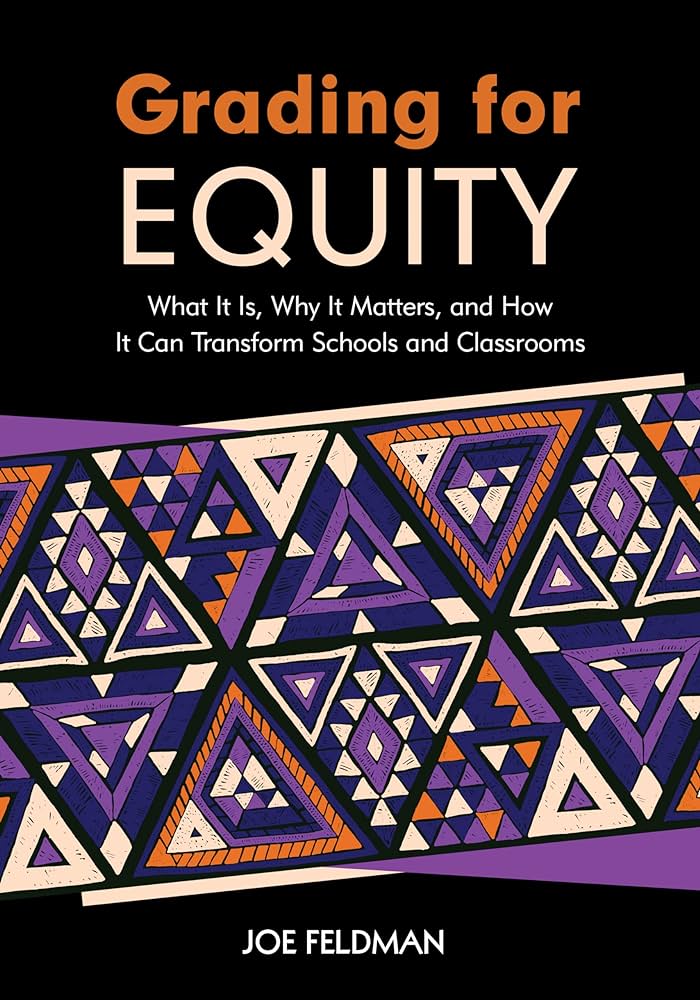
As of August 2026, committee members included math teachers Christina Graham and Michael Yalch, language arts teacher Cameron Barnett, Spanish teacher Marla Greenwald, Director Jill Sarada, Director of Student Services Joanna Newlin, and Floro. During the 2025–26 school year, Outerbridge and Picklo were also members.
As Feldman outlines in his book, the issue with most traditional grading systems is that they allow too much space for subjectivity. By combining factors like effort, participation, classroom behavior, and content mastery, grades are often skewed in ways that ultimately hurt rather than help students.
On top of that, many systems lack opportunities for relearning and reassessment, which discourages students by requiring them to succeed at a single, arbitrary point in time rather than treating learning as an iterative and progressive process. These pitfalls create an environment where grades are often inaccurate and where students are so anxious about how to earn more points that they lose sight of the real purpose of school: learning.
To shift this mindset, the Grading for Equity committee explored practices like reassessment plans and nongraded homework, with the hope of identifying school-wide changes that can improve and standardize Falk’s approach moving forward.
Across the committee, teachers experimented with new rubrics and scoring methods, largely modeled after Feldman’s 4-point scale or the single-point rubric. In these competency-based models, student work is assessed on whether it meets the standard rather than assigned a unique, often arbitrary score from 0 to 100.
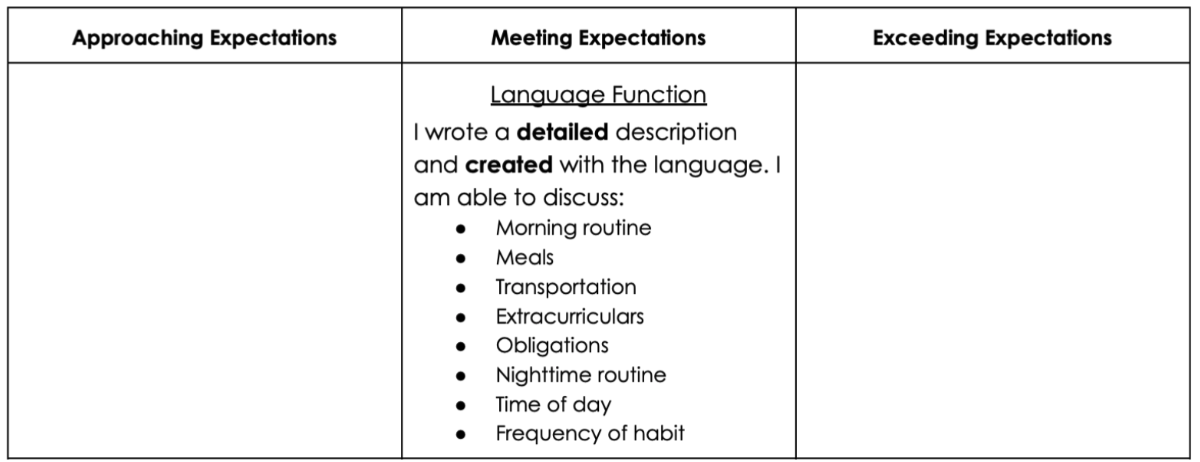
A sample single-point rubric from Marla Greenwald's Spanish class
Just like with traditional rubrics, Barnett explains, you can still have as many categories as you need. In an essay project, for instance, a student might be assessed on conventions, length, and narrative composition. The difference is that the only available “scores” for these categories are Not Meeting (or Approaching) Expectations, Meeting Expectations, and Exceeding Expectations.
This approach leaves little room for teacher subjectivity and student frustration. Questions like “Why did I get a 72% when my classmate got a 74%?” and “How do I raise my grade from an A- to an A+?” become obsolete, encouraging students to instead focus on developing the skills they need to demonstrate understanding.
After piloting the rubric with his eighth graders, Barnett says he’s seen this shift start to take place, with students now asking how to master specific aspects of writing rather than how to bump their grade a few extra points. The approach also forces teachers to proactively define what it means to meet the standard, resulting in clearer, more objective learning targets.
This work also supports Falk’s curricular mapping, an ongoing process to establish clear priority standards and big ideas across grade levels and disciplines. “Together, we are creating greater clarity and precision around our learning objectives and achievement reporting,” says Floro.
In Spanish class, Greenwald has stopped factoring classwork, homework, participation, and effort into students’ final grades, opting instead for summative assessments only. In addition to eliminating inflation, Greenwald says this shift has given her students the freedom to make mistakes, boosting their willingness to take risks and try expressing themselves in the language they’re learning.
Graham and Yalch have a similar approach in Middle School math. “We have never counted homework or participation towards the grade,” Graham explains. “We want the homework to provide an opportunity for independent practice, to reinforce the concepts explored in class. Rather than grading it for points, we use a check, check-plus, or check-minus as a feedback tool.”
This feedback is shared with students and families each trimester without affecting the final course grade. “We report on things like homework and participation in our progress report checklists, which speak to habits of mind and the ways we see kids engaging,” Graham says. Checklists are presented alongside the course grade, offering both an objective assessment of content mastery and feedback about student engagement and disposition.

This work reflects faculty beliefs about the scope and purpose of homework, as captured in a survey for Middle School teachers in December 2025. In it, 67% of participants reported being Mostly Aligned or Fully Aligned with Feldman’s belief that homework should not distort a student’s academic grade, with zero respondents disagreeing. Half of surveyed faculty members also said homework’s primary purpose is to build responsibility and executive function—a belief that aligns with nongraded and intrinsically motivated assignments.
For Floro, a big part of equitable grading and instruction is the idea that “We don’t go on without you.” Practically speaking, this means offering opportunities for relearning and reassessment, so students who mess up on one exam aren’t left struggling to dig themselves out of an impossible hole. Having equitable reassessment policies also shows students that learning doesn’t stop after a test; it’s a continuous, iterative process.
This past school year, Graham rolled out a new reassessment policy with her eighth graders, in which students complete a self-reflection, schedule one or more reteaching sessions, and set up a time to take a brand-new (but similar) version of the original test. During the reflection phase, they fill out what Graham calls a “Mathematics Assessment Reflection and Plan for Relearning,” which asks them to consider why they haven’t yet shown proficiency—for example, lack of preparation or rushing through the test—and sign the following statement:
“I understand that reassessment is an opportunity to show what I have learned after additional practice. By signing, I commit to my relearning plan and will be ready on the scheduled reassessment date.”
Using this process, Graham says she’s seen students go from a failing grade to an A, including some who told her they didn’t think they’d ever be capable of earning an A. The system doesn’t just prevent students from being left behind—it promotes confidence, autonomy, and true content mastery, all of which drive student growth.
Despite the many successes of Falk's Grading for Equity exploration, new ideas always present new challenges, and this endeavor is no exception. For one thing, it was difficult to introduce concepts like nongraded assignments and single-point rubrics to eighth graders, who are already deeply ingrained in what Floro calls the “school game” by the time they reach their last year at Falk.
Unsurprisingly, Barnett says he noticed some confusion and frustration when he transitioned to a competency-based scale. However, this pushback led to mutually informative conversations about the motive and anticipated outcome of the change. As Floro says, “When you’re trying something new, having to defend it and justify it helps you internalize it a little better. Conversations [we] had to have with kids helped formulate why we’re doing this and what [the work] means.”
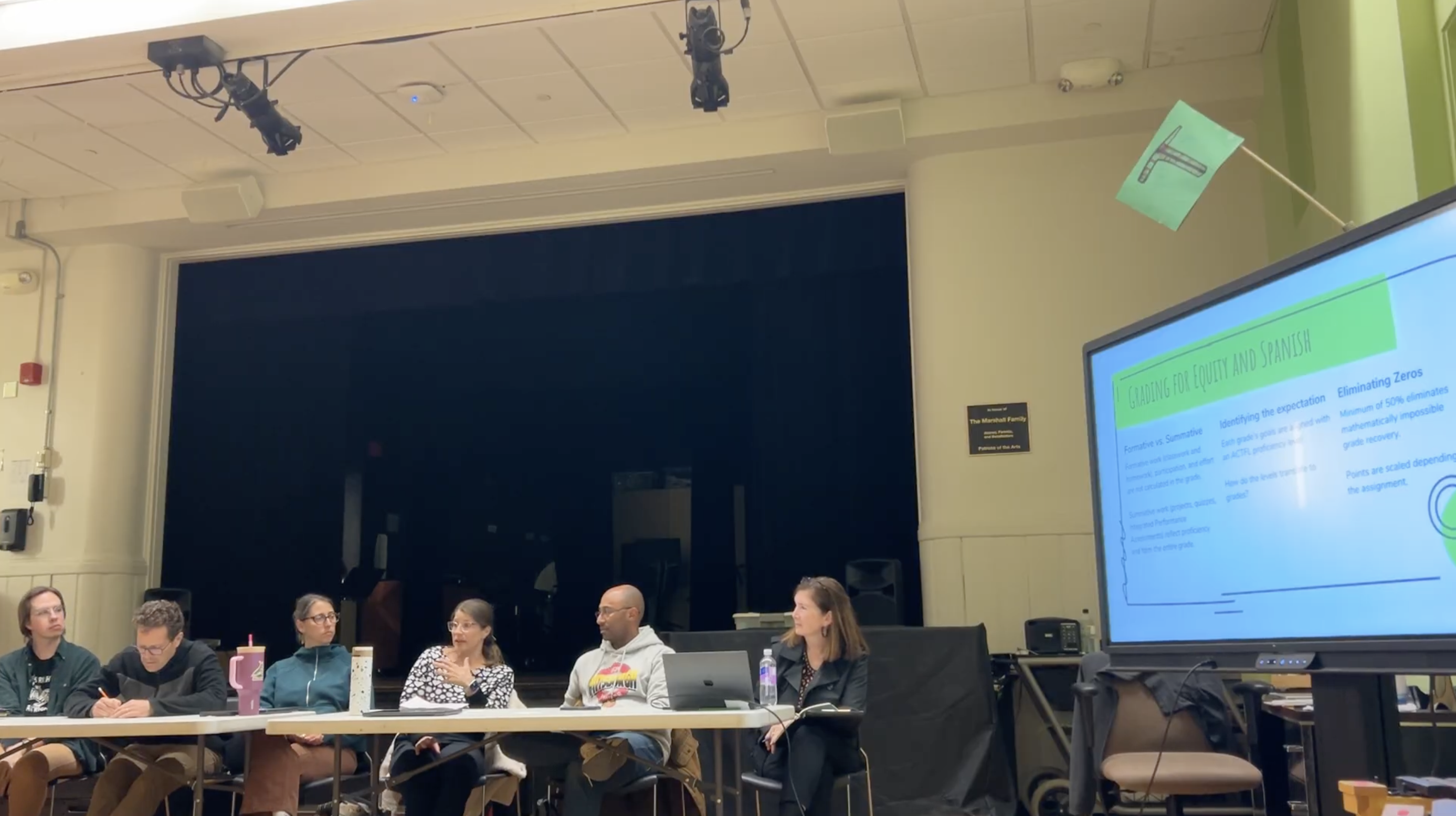
Falk's Grading for Equity committee presenting at the April 2026 faculty meeting
Other questions the committee continues to grapple with are: How do we maintain student motivation in a system where daily assignments aren’t graded? How can we assess and provide feedback on things like participation, disposition, and classroom behavior without including them in the final course grade? At what point, if any, does reassessment lead to grade inflation? And, perhaps most importantly, how do we move these practices forward when the well-established “school game” opposes them?
While the committee has undoubtedly made meaningful progress in its first year, Floro says there's still a long way to go to bring their ideas to fruition across the school. “Learning is messy, not easy,” she says, “That’s a space we’re still in.”
For Barnett, the most important takeaway of the past year was understanding where the school currently stands. “[The process has made] me very aware of our larger structures and what is possible right now and what may be possible in the future."
One opportunity that will definitely continue is a collaborative partnership with Winchester Thurston School, who started a similar equitable grading exploration just a few years before Falk. After connecting with Amanda Welsh, Assistant Head for Teaching and Learning, Floro discovered that Winchester’s faculty committee includes Spanish, math, and language arts educators—the same content areas represented on Falk's committee. This connection has provided an outlet for sharing ideas and expertise and will continue to enrich Falk's understanding of equitable grading moving forward.
In the short term, Floro and the Middle School team are working to create a standard translation algorithm from competency-based grades to traditional letter grades so that student reporting remains consistent regardless of a specific teacher’s practices. In the long term, they hope to switch to an exclusively competency-based system, where all teachers, along with Falk’s student information system, use Feldman’s 4-point model or a single-point rubric approach. This transition will also coincide with other school-wide shifts, such as eliminating zero grades, clearly defining learning targets, and refining reassessment practices.