



Discover our
Home for Learning
- Contact
- 412-624-8020
- [email protected]


In the last issue of En Avant magazine, we took a close look at Universal Design for Learning (UDL), a teaching framework that proactively accommodates all learners by offering multiple means of engagement, representation, and expression.
During the 2024–25 school year, faculty studied these key UDL principles, and during the 2025–26 school year, they put their knowledge into action, both as a whole school community and in their respective classrooms.
Across grade levels, teachers experimented with representation using visual schedules. While many teachers simply refined one they already had in their classroom, others developed theirs for the first time last year.
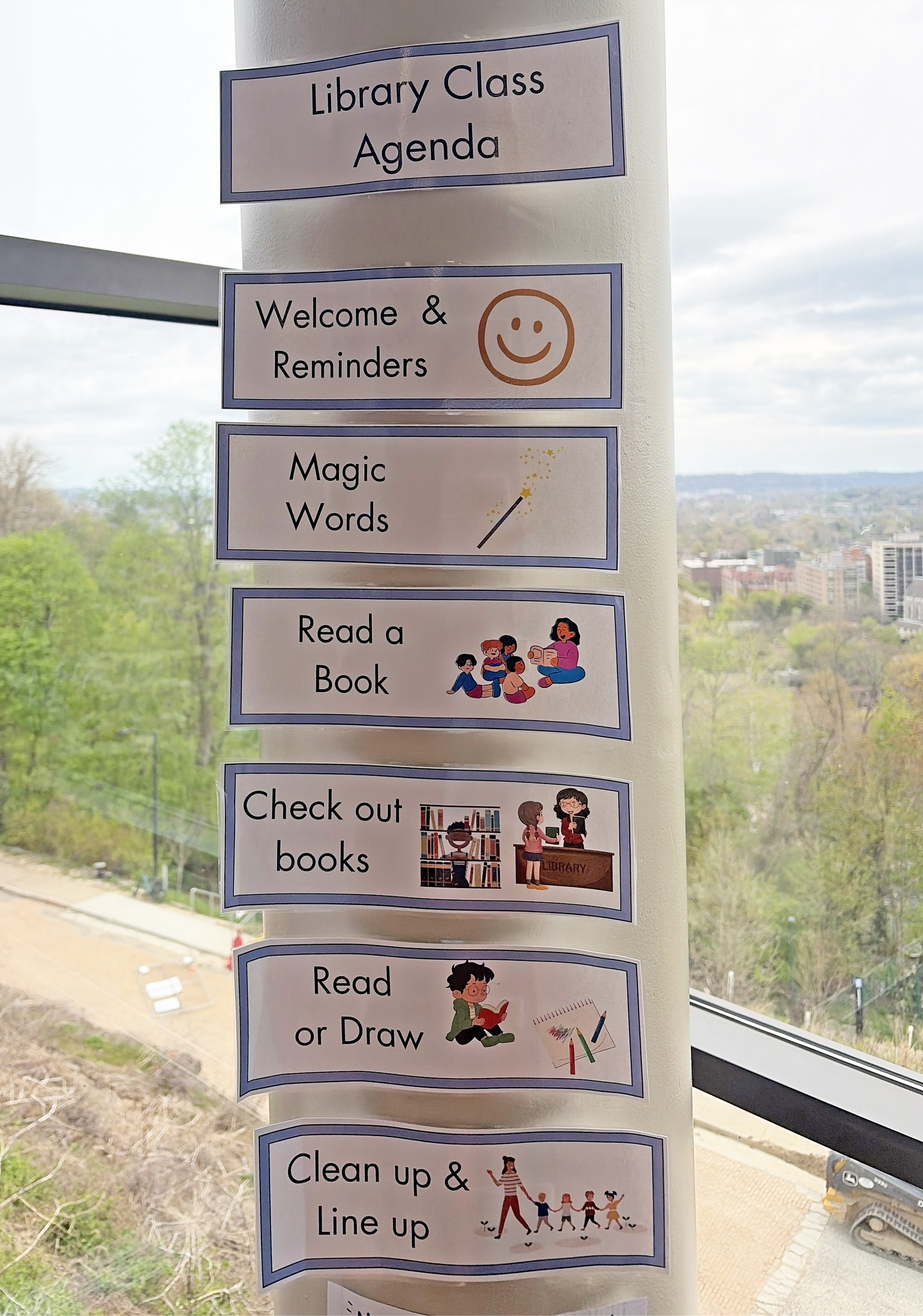
Librarian Emma Kagan's visual agenda
For younger grades, these schedules often take the form of pictures and single-word phrases, while Middle School faculty write out more detailed tasks and events. Regardless of style, presenting the schedule visually provides all students with a concrete, visible way to prepare for the day.
Another school-wide change piloted last year was the addition of a calm corner to every space in the building. Like visual schedules, many classrooms already had an area for students to quietly reset, but it wasn’t yet consistent. Standardizing this practice was a way to promote self-reflection, agency, and flexible learning environments, all core components of UDL.
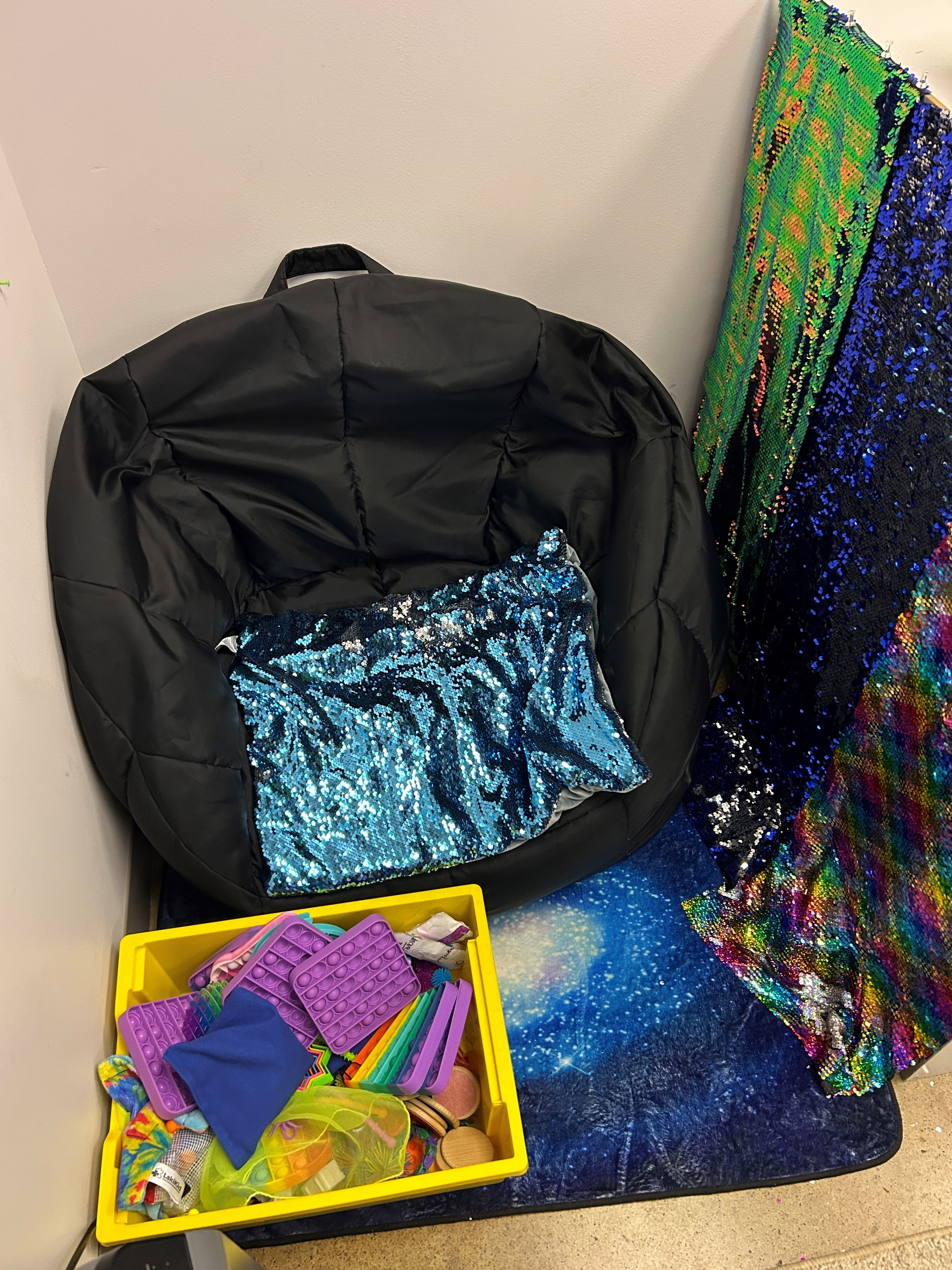
Academic interventionist Lindsey DePra's calm corner, featuring a bean bag chair and fidget toys
In October 2025, just two months into the school year, over 70% of teachers reported that their calm corner was “Helpful” or “Very helpful” for the class. A similar number shared that the space was used by at least one or two students each day.
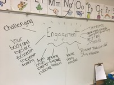
All faculty members were also asked to pilot a Plan-Do-Study-Act (PDSA) cycle centered on the first UDL principle: multiple means of engagement. Using guidelines from CAST, Inc., they split into self-selected groups focused on Welcoming Interests & Identities, Sustaining Effort & Persistence, or Emotional Capacity (see graphic below).

After discussing relevant strategies, such as offering doodle notes instead of traditional notes to welcome diverse identities, they brainstormed ways to incorporate them into their practice. Next, they planned and executed specific implementation steps, studied the results, and acted on their findings by either adopting, adapting, or abandoning their chosen strategy. Throughout the year, this progress was tracked and shared during school-wide faculty meetings.
Now let’s get into some specifics. In her classroom, Christa Cooke spent the year exploring what it means to be a writer in first grade. To answer this question, she teamed up with Elementary Division Director Autumn Dillaman to create a series of writing templates, each with a different structure, layout, and/or physical page shape.

Throughout the year, students were encouraged to choose their own templates for in-class writing time. In addition to promoting metacognition and critical thinking skills, having students reflect on the available choices and select an option that fit their needs offered multiple ways to engage and express authorship.
Leaning into the power of choice, Cooke also let students choose whether they wanted to work with partners, a practice she says “absolutely changed engagement. There's a lot of agency, and there's been a lot of enthusiasm because I'm not giving a [one-size-fits-all] direction. The entire month of March, they [couldn’t] stop writing.”
Together, Cooke adds, the templates and thinking partners created a space where “everyone [could] be a writer in first grade, but in different ways.”
Jenny Brent has also seen a surge in student engagement following Falk’s UDL explorations. Although the framework was always part of her practice, she says the time devoted to school-wide reflection and implementation over the past two years has made it a more consistent part of her lesson planning.
In a unit on the rock cycle, for example, Brent made sure to include several means of content representation, including reading, watching videos and songs, and examining real rocks together. “We also did a hands-on activity with Starbursts,” she says, “where students cut up the Starbursts into sediments, and then we added heat and pressure and melted them to work through the rock cycle in a hands-on way.”
At the end of the unit, her students were also offered several ways to express their knowledge, ranging from comic strips and essays to picture books they could share with their kindergarten reading buddies.
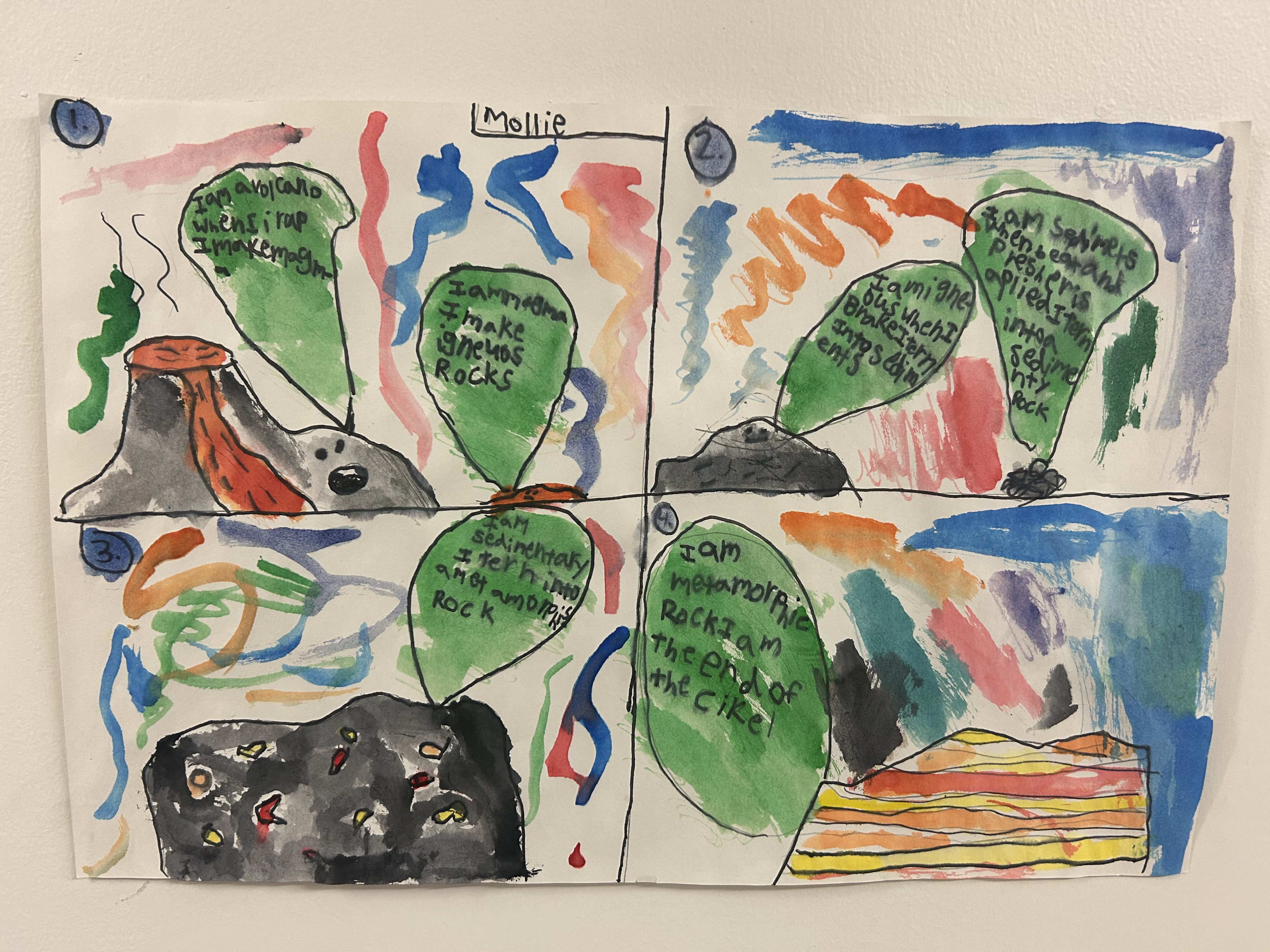
A common misconception about choice-based learning, Brent adds, is that students will simply choose the “easy” way. When UDL is executed successfully, however, that’s really not the case. “Everyone's accomplishing the same learning goal—you're telling me about the rock cycle, you're using these five vocabulary words—but the way you show that to me can be different. I don't see them choosing based on, ‘oh, this is the easy way, so I'm going to do it this way.’ It's more like, ‘oh, this is how I really enjoy learning,’” she says.
“It’s much more authentic to who they are, because you kind of see their personality and a lot more of who they are in their work. When they have that choice in the project, their engagement, their buy into it, is so much bigger.”
Kate Petrack experienced the same phenomenon when she offered fifth-grade students multiple ways to present their freedom fighter research last spring. Over the course of five months, students picked a historic or modern-day changemaker, researched their life's work, wrote a five-paragraph essay on their contributions to society, and then completed a creative project to share with their peers and families.

Rather than having everyone make a poster for the final showcase—as is often the case in school research projects—students had the opportunity to explore songwriting, filmmaking, dioramas, skits, speeches, and illustrated timelines. Two students even chose to write and record an original rap song. For each project type, Petrack created a checklist and planning sheet, and for the entire class, she built a rubric that assessed content understanding, creativity, thoughtfulness, and conventions.
On April 2, 2026, students presented their projects to a room full of proud parents and returned home at the end of the day with a unique sense of accomplishment. Petrack says the whole experience boosted student investment and engagement and “felt much more genuine and authentic to them. I think they walked away with more out of it.”
At the Middle School level, learning specialist Gina Henderson has explored several UDL applications with her students. As a member of the learning support team, “I'm not really designing [the curriculum] myself,” she says. “I'm supporting and enriching what teachers are designing. I'm seeing how I can help [students] express their learning without being overwhelmed by the assignments.” In many cases, this happens during resource periods, when Henderson meets with groups of three to five students to offer extra academic and executive function support.
Henderson says Falk’s focus on UDL over the past two years—especially her time facilitating the faculty book club on “Unlearning: Changing Your Beliefs and Your Classroom with UDL”—has solidified her understanding of the approach and helped her reframe learner variability as an asset. Everyone has unique and complementary strengths in life, she explains, and UDL is a way to teach more effectively by leveraging those assets.

One way Henderson does this is by offering multiple pathways for engaging with and mastering content. Last school year, for instance, some of her sixth-grade students were struggling to prepare for a science test on unit conversions. Because each student was approaching the test from a different starting point and with a different learning profile, Henderson offered several ways to study, including flashcards and personalized mnemonic devices.
For students who needed more intensive support, she started with a small subset of the flashcards and slowly introduced more complex vocabulary and symbols over time. This approach offered both choice and targeted intervention, perfectly blending the UDL framework with her role as a support specialist.
Henderson’s PDSA cycle was also at the intersection of UDL and intervention. Focusing on the Emotional Capacity component of engagement (see CAST, Inc. guidelines), she helped students develop intrinsic motivation and awareness by reflecting on their habits and identifying what helped them achieve success.
After a long-term assignment or test, Henderson would ask students to compliment themselves by naming one thing they did well—establishing a homework routine, studying effectively, or feeling prepared for the assessment, for instance. These reflections were the “Wow!”
Next, students reflected on the “How?” How did you find a good routine? How were you able to study better? How did you end up feeling ready for the assessment? The answers to these questions—for example, consistently organizing my binder by unit—then become change ideas that students can implement to support their long-term learning.

Throughout the school year, Henderson made these reflections visible by posting them on a bulletin board in her workspace. On the left, represented by a green plus sign, are positive self-reflections, and on the right, represented by a blue delta symbol, are ideas for change and action. Henderson says the process has been “really powerful” for her students and is now a natural and impactful part of their routine.
While last year’s PDSAs focused on engagement, this year’s will examine methods of representation, the second principle in CAST Inc.’s UDL framework. Amidst this transition, the many teachers who had already expanded to representation and expression will continue to do so, sharing their findings with each other and the Falk community.
For Petrack, expression is actually the easiest principle to understand and implement, despite being the last step in the framework and Falk’s anticipated focus for the 2027–28 school year. “Thinking about how that choice shows up in the representation and engagement areas as well is something I'm continuing to work on.”
By the end of the 2027–28 year, the hope is that all three principles will become part of Falk’s shared framework so that “over time, it's so embedded that it's not an extra thing,” Cooke shares. “It won’t be like, ‘oh, today I'm doing UDL.’ It'll [just] organically be in your practice."
Deeply intertwined with this work is the ongoing school-wide curriculum mapping that will clearly define course learning targets to establish unity across grade levels and vertical alignment within disciplines. These refined targets will provide shared goals and guidelines for choice-based learning, supporting Falk’s continued UDL exploration.